
Zero Waste Pattern Making: How It Actually Works at Production Scale
Do zero waste patterns actually work at scale?

Zero Waste Pattern Making: How It Actually Works at Production Scale
As someone who has worked in the zero waste design space for over 15 years, I get this question a lot.
Do zero waste patterns actually work at scale?
The short answer?
Yes!
The long answer is, well, long. We won’t get into all of it here, but we will go over some of the considerations.
Having been in this industry for a while, I know the exact reaction you get when approaching a factory for producing a zero waste design. Annoyance, confusion, or just plain “no.”
Often times a designer or brand looking for zero waste manufacturing is not producing at a scale or budget that is worth the time of the manufacturer.
My experience
In 2021 I opened my own micro-factory to solve this very problem. I hired and trained staff to cut and sew zero waste apparel from the ground up, growing to 8 staff at our time of highest volume. We produced DECODE zero waste blanks and collaborated with partners on limited run collaborations & artist series. It was challenging finding other designers looking to produce zero waste, so I was also pitching design work in tandem with manufacturing. It was building the plane while flying it, and we grew too far too fast. We ended up closing in 2023 due to a variety of issues, but the knowledge I gained throughout the experience has remained.
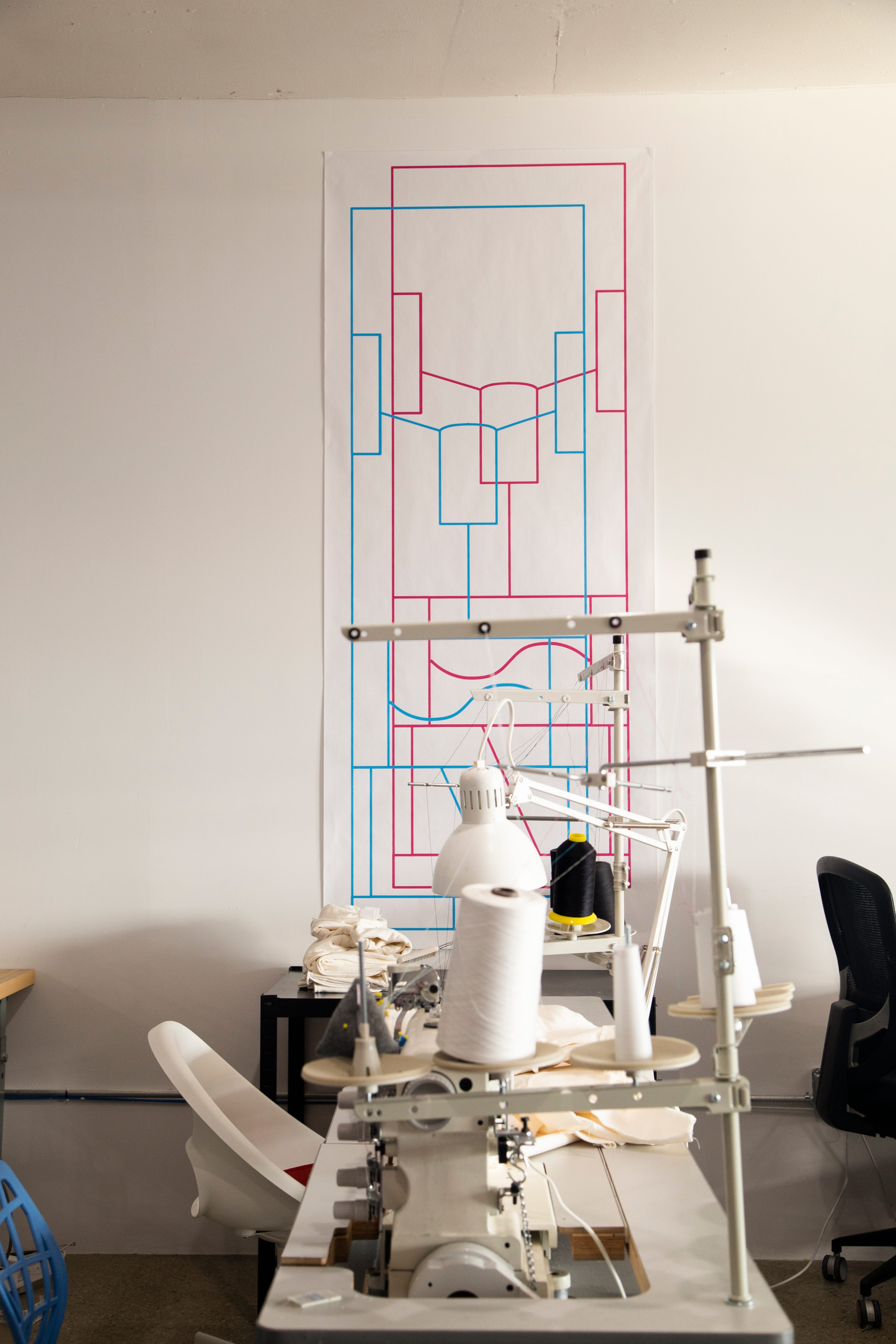
I gained a ton of insight into the zero waste manufacturing process at a larger scale and how to get the “yes” from more standard manufacturers.
I have worked with many large companies over the years where I have needed to insert myself into their manufacturing system, rather than finding my own. This can be a challenge, as factories are well-oiled machines that don’t like disruptions.
Manufacturing a zero waste garment requires working differently. It requires circular design process rather than linear. A linear design process is a one way information road, where a designer sends a sketch to a tech designer, who then sends a tech pack to a pattern maker, then a nesting and grading specialist, with no room for feedback on improvements back up the chain of communication. A circular design process revolves around an innate feedback loop, where a designer is also working on patterns, grading, nesting, and material selection together. This of course looks different for differently sized companies when larger teams are involved rather than an individual.
Working this way can cause conflict working within a well established system. It can feel threatening to have someone come in and try to give input on your role or outcomes, especially if you’re an expert who has been in the field for a long time!
Someone told me lately that it sounded like I’m a relationship manager, which made me chuckle. It’s true! Making sure every partner in the process feels valued, heard, understood, and encouraged to try something different is a whole job on its own.
All of that said, there are good examples of projects that have made it from concept stage to production and beyond. Last year a project I worked on with Manduka came out, called the Unwasted Collection. You can check out more info on that link, and watch a video on the process here:
It was a great experience working behind the scenes on this project, I really got to embed with the production and manufacturing team to figure out long term solutions for manufacturing this collection.
I can share more about the process behind this collection in another post.
Below are some of the key things to keep in mind when trying to scale your designs to be manufactured by someone other than yourself.
Considerations
Scale can mean many things, from tens, hundreds, or thousands, to hundreds of thousands of units.
In these examples I’ll mainly be speaking on the larger end of that scale. Typically a large manufacturer won’t even entertain a conversation unless you’re speaking thousands of units.
A small local manufacturer might not have some of these same hesitations and will be more willing to work with you on the tens to hundreds of units scale.
If you’re able to get the okay from a factory based on scale/budget, this is where some of the technical hurdles come in. The largest of these is interestingly software. You will need to submit your designs as a digital file. Every major system out there, Gerber, Lectra, Optitex, CLO3D, etc. operates from the same algorithmic logic. They’re designed to minimize waste, not to eliminate it. Traditional nesting software works by taking existing pattern pieces and arranging them to use fabric as efficiently as possible. The system assumes that waste is inevitable and simply tries to reduce it by fitting pieces together more tightly or rotating them at different angles. (There are a few startups that are trying to tackle this, but none at an industrial scale that i have encountered so far. )
There is no getting around this at the moment except for manual manipulation. I have to ask manufacturers to bypass their nesting software, which makes them quite uncomfortable. It also steps on the toes of the pattern maker which can cause some issues. I have a few examples where this happened in real time that I will share as case studies in the future.
The other hurdles that come up are around grading and nesting. There are viable solutions for both! Often what it comes down to is designing onto a fabric width that already exists. If you plan a pattern for a theoretical fabric, or change fabric widths, the manufacturing process will either halt while you adjust your pattern, or become not zero waste.
Grading zero waste is completely possible and is done by nearly all zero waste designers I know. You are able to nest compatible sizes together on a fabric width in order to use the full width of your fabric, without having to change the fabric or lay plan from size to size. Grading and nesting go hand in hand with zero waste design.
I won’t go into all of the techniques here, but am exploring them in the book that I am currently writing on my zero waste design system.
Another big hurdle is transparency, more specifically, finding a manufacturer to work with you that is willing to share their data. It can be a deal breaker to ask to see a factory’s production marker and their info on yield and consumption for a few reasons. In many manufacturing partnerships the marker layouts and pattern blocks are treated as the factory’s confidential workflow or proprietary asset. Factories may be reluctant to hand over marker files, grading blocks, or layout strategies because these files are part of their internal production system and competitive advantage. Finding a factory willing to work with you in this way is maybe one of the most important things you can do!
Finding a factory that aligns with your ethics of production is another key piece to this puzzle. Ensuring a factory adequately pays their staff and provides safe working conditions seems like a no-brainer, but it’s unfortunately not. Visiting a factory location and digging into their certifications and standards can go a long way.
Cost is a huge question and consideration. Lots of people ask if it’s more expensive to manufacture zero waste. The short answer is that it depends. If we are comparing a standard non-zero waste garment to a zero waste garment that use the same fabric, same general style, etc, we can compare. Having a base starting point is important when calculating this! You need a “before” to your “after.”
The amount of fabric you save for a zero waste garment is typically around 15-25%. The cost of your fabric will determine how many dollars that saves over however many garments you produce. If your fabric costs $10, that’s $1.50-$2 saved.
Your zero waste garment may have an extra seam or two, or complicated construction in order to achieve no waste. You can ask the factory for their seam sewing time/cost. Usually there is a figure associated with one minute of sewing time on specific machines. Let’s say you add 15” worth of seaming and it adds 2 minutes of time to the construction. If a minute of construction costs $.50, you’ve added $1 to your manufacturing costs.
In this example you still break out ahead on costs. If your fabric is very cheap or labor very expensive, the calculation flips and it can be more expensive to produce a zero waste garment. Holly McQuillan shares some excellent examples of this in her PHD.
Either way, a factory may charge you a hidden inconvenience fee because they just don’t want to do it.
This is not an all encompassing list, but it gives you a few points to consider. All of that being said, there are quite a few of these pain points along the zero waste manufacturing journey, but knowledge is power! I can help you avoid some of these road blocks going forward. You can follow along on my website to see more projects and get updates on the aforementioned book I’m working on.
My colleague Cass and I will also be holding a “Manufacturing for zero waste” class online sometime this fall. You can follow our page Cut to Zero for more updates!
If there is a specific question related to zero waste manufacturing that you would like answered here, let me know.
Thanks for reading!
<3 Danielle